Cocoa Chronicle 2: Kumasi to Kyebi, for Cocoa, Culture and Curiosity


I climbed onto the minibus that would take us from Accra to the Ashanti region and grabbed a window seat. The sun was out, and so was the excitement for the trip ahead. The team I was traveling with carried on boisterous conversations, and after quick introductions, I sat quietly, my nose pressed to the window, taking in the scenery. “Lush greens, palms, mountains covered in greenery, pawpaw and plantain farms” — I noted in my Notes app, after it occurred to me that this trip would be worth journaling. Five days into my arrival in Accra, I was already on my first expedition, headed to a place that had existed only in theoretical terms in my research.
My host (let’s call her “Mama”), a former journalist and brilliant communications strategist in the development sector, had informed her friends about my work and need for support. My trip to Ghana was to collect primary data through focus groups and interviews with multiple stakeholders in the cocoa sector. It felt daunting since I knew no one here except for Mama, the mother of my friend, whom I met during my master’s program. Before I arrived, she had secured a meeting with Dr. A, a principal manager at an international nonprofit focused on responsible production in the agricultural and forest commodities sectors.
In our meeting, we reviewed my field research plan, and thankfully, Dr. A provided contacts for nearly all the organizations on my list. He made a few calls and even arranged meetings with key figures. He also informed me of an upcoming exciting program launch event for deforestation-free cocoa supply chains in the Ashanti region. He suggested it would be an excellent opportunity to observe and connect with farmers, cooperatives, certification bodies, and donors. So, that’s how it happened: on Thursday morning, I was in a minibus with a team of 5 that I had just met (except for Dr. A), making a trip to the Ashanti region. Fortunately for me, what was supposed to be a networking endeavor turned into an unexpected journey — heading deeper into the Ashanti region, where the real work and discoveries would begin.
An excellent first date with the Ashanti Region
As we drove through Suhum in the Eastern Region, Dr. A asked me whether I had ever seen a cocoa farm. Part amused, and part appalled, I confirmed that I had not. For the last two years, my focus on cocoa and its impact on farmers and ecosystems has been driven by a desire to improve outcomes. Yet, I realized how far removed I was from the realities I had been striving to understand. It is not lost on me the parallel between this and the broader development contraption, where technical experts thousands of miles away, running on coffee and ambition, develop policies and programs that supposedly empower people and systems they have no experiential or nuanced understanding of. And this is one of the most vital reasons I knew I would opt for applied, primary research with facets of multi-stakeholder engagement. Following my confession, Dr. A., who had become my unofficial tour guide, pointed out the COCOBOD seed gardens and cocoa farms lining the expressway. Although we sped by, I was excited to catch glimpses of the trees and leaf-covered farm floors. We arrived in Kumasi at night, and it only took the crackle of activities for me to realize it. It was far from chaotic, but the city was alive with commerce, music, and the air that carried echoes of conversations, loud and low. And even though Kumasi would only be where we spent the nights on this trip, I guessed I would like it there.
The morning started on a cautionary note - I had spent the night nursing a bout of diarrhea. Fortunately, a kind Bolt driver had helped me get some medication. This, along with many other interactions, solidified my opinion that Ghanaians are some of the warmest people I’ve met. The morning air was slightly cool, and the sun made a grand entrance as we drove away from Kumasi toward Kyebi, a small farming community in Offinso Municipality. Nose to the window, I took in sights of lush greenery surrounded by hills and rocks, fruit plantations, including pawpaw plantations I’d never seen before, and road constructions that created clouds of red dust as we drove through Barekese.
We arrived at the launch of the ‘Partnership for Deforestation-Free Cocoa Supply Chains’ program, a joint effort by Fairtrade International, Proforest, and IKI. In alignment with Ghana’s REDD+ strategy and the EU Deforestation Regulation, this initiative targets 14,000 cocoa-farming families in the Ashanti, Eastern, and Ahafo regions, focusing on agroecology, financial inclusion, gender equality, and youth involvement. Essentially, Ghana’s cocoa farmers, who actively struggle with profitability, knowledge gaps in climate-smart approaches, and environmental degradation (partly from deforestation), would be empowered to grow cocoa more sustainably through the integration of agroforestry and in compliance with EUDR, securing their access to European markets. The launch consisted of a slew of speeches, predominantly in Twi, from representatives of partners spearheading the program and of domestic institutions such as COCOBOD, the Forestry Commission of Ghana, and Offinso Municipality. The common thread was a commitment to a collaborative approach toward climate resilience and adaptation.
Amid the technical discussions of climate resilience and sustainable cocoa, witnessing the adowa dance provided a vivid reminder of the culture that grounds it all. A young dancer, dressed regally in local print wrappers and colorful powder glass beads, danced with elegant hand and foot movements to the rhythms of drums and theresonant tones of bells. I’d seen videos of this dance before now. Still, in person, it was an enthralling experience that had me tapping my feet and swaying in my seat, a testament to my love for Indigenous African music such as the ‘ogene’ played by my tribe - the Igbos. As the tempo picked up, some of the farmers sprang to their feet and joined in the dance; their feet lost in intricate legwork that matched the drum's reverberations. Sen’s concept of “development as freedom” came to mind at that moment. The whole point of our work should be to empower people for the sake of agency, dignity, and their freedom to function effectively in the spaces they operate in, without constraints that strip them of the things they choose to value.
The drive from Kyebi back to Kumasi was a delight. I reveled in meeting several cocoa-farmer cooperative leaders and other sector stakeholders. Still, my delight grew in bounds as I soaked in the beauty and wonder of the landscapes and snapshots of the lives of the cocoa farmers we drove past. I saw cocoa farms, cocoa beans drying, pawpaw plantations, and compounds surrounded by rows of palms—each sight evoking nostalgia that carried me back to similar scenes from my childhood. A heartwarming stop at a buka-style restaurant in Offinso gave me the chance to try the popular fufu with light soup after much convincing from Dr. A., and to my surprise, I loved it. Back in Kumasi, my final night was spent in conversation with the team I traveled with as we strolled down the road from our hotel to grab food, in my case, fried rice with fresh pineapple and ginger drinks.
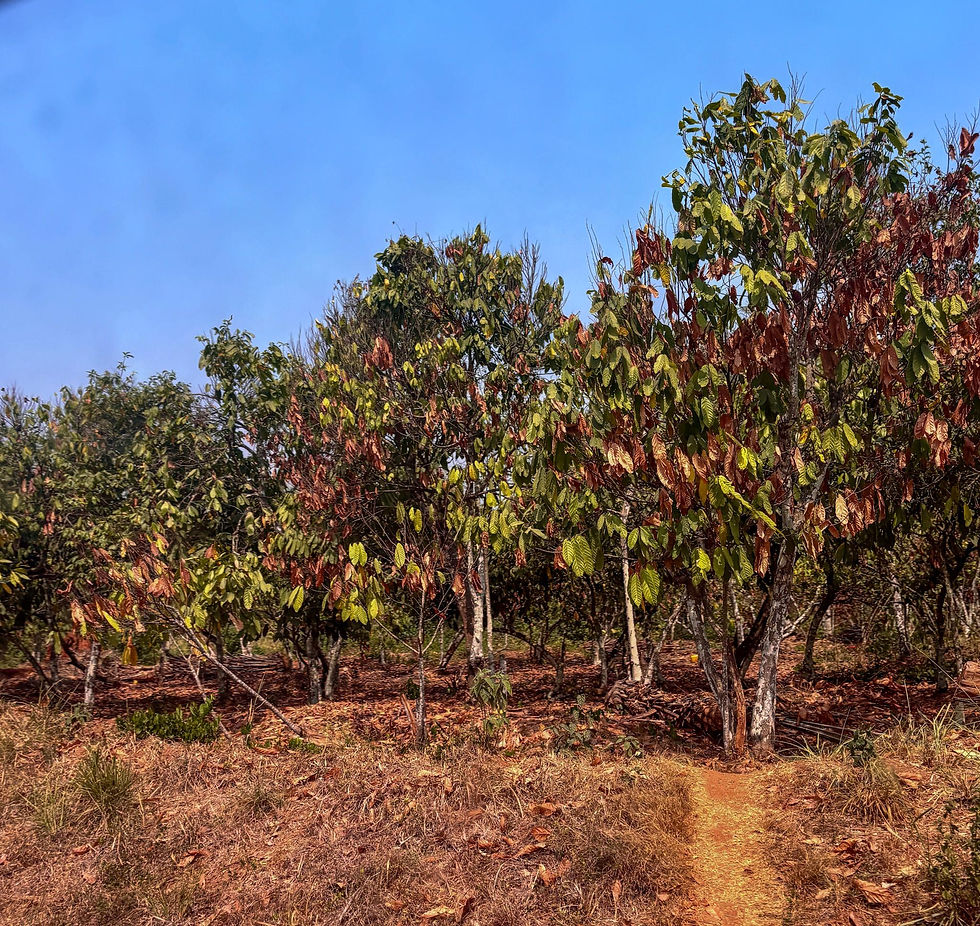
A roadside cocoa farm in Kyebi community, Ashanti Region, Ghana

I experienced the beauthy of adowa dance for the first time in Kyebi, Ashanti

A pawpaw farm between Kyebi and Offinso towns had me wide-eyed as we drove past.

In Offinso, I had my first plate of the infamous fufu and light soup, and I've never looked back! :D

A smallholder cocoa farming family's compound in Kyebi, with cocoa beans spread out to dry on a mat
You would think that the drive back to Accra from Kumasi would be drab, a welcome chance to sleep off the fatigue from all the traveling we had done in the short span of two days, but the journey turned out to be one of the trip’s highlights. The morning started with a Jollof war - the infamous argument between Nigerians and Ghanaians over whose jollof rice is better. It did not matter that I was outnumbered by Dr. A. and JP because “Naija no dey carry last!” However, I was convinced to order the assorted jollof from the popular restaurant at Anita Hotel. Another option was ‘the Anita Special’, which I learned is a famous choice, but since this was about Ghana Jollof winning me over, Jollof it had to be. We grabbed the food and hit the road, but an uneventful stretch had me nodding off in a surprisingly peaceful sleep. I woke up hungry, and I must confess, nothing had prepared me for how delightfully delicious the jollof meal from Anita’s was, and the risk of losing my Nigerian passport, I have to say that it was delicious!
The last lap of the journey through the Eastern Region had us drive through Koforidua, where I got to hear all about the “Koforidua flowers” - a moniker given to the women of the town who are widely regarded as some of the most beautiful in the country. At Adawso, we stopped at fruit markets where I was gifted bags of udara/alasa (African star apples), pineapples, oranges, and the largest, juiciest mangoes I have ever had. We sighted a wagon of coconuts by the expressway and made an impromptu stop when Dr. A. learned I’d never had coconut water straight from the coconut. After a mini coconut-drinking excursion, we made no other stops until we arrived back in Accra. Climbing the stairs to my flat with hands full of fruits, I felt my heart mirror the bounty I was carrying.
Research should be about immersive learning and seeking answers to questions that challenge our constructs and advance intelligence beyond academics. This trip was a reminder that education should be less about the regimented acquisition of knowledge and more about opportunities that allow us to redefine and expand the ways we create value for the sake of both individual and collective advancement. As I reflect on this journey, I realize the power of participant observation — an element I hadn’t explicitly woven into my research design. Yet, it’s becoming one of the most game-changing aspects of this data collection process. Being immersed in the environments I’m studying, not just as an observer but as an active participant in the community, offers insights that conventional data alone may never provide. It’s a reminder that sometimes the most valuable learning happens outside structured research plans, through spontaneous connections and experiences that unfold when you’re truly present in the moment.

A rushed shot of the entrance of the renowned Kwame Nkrumah University of Science and Technology, Kumasi

The popular Eastern Premier Hotel in Koforidua, Ghana

Coconuts in a wagon by the roadside in Mamfe, Eastern Region
Me, enjoying coconut water in the middle of the proverbial "nowhere" (as proof that all this happened) ;)
If you got this far, you must have some thoughts about what you've read. Don't leave with them; let us chat in the comment section!

Comments